
Introduction
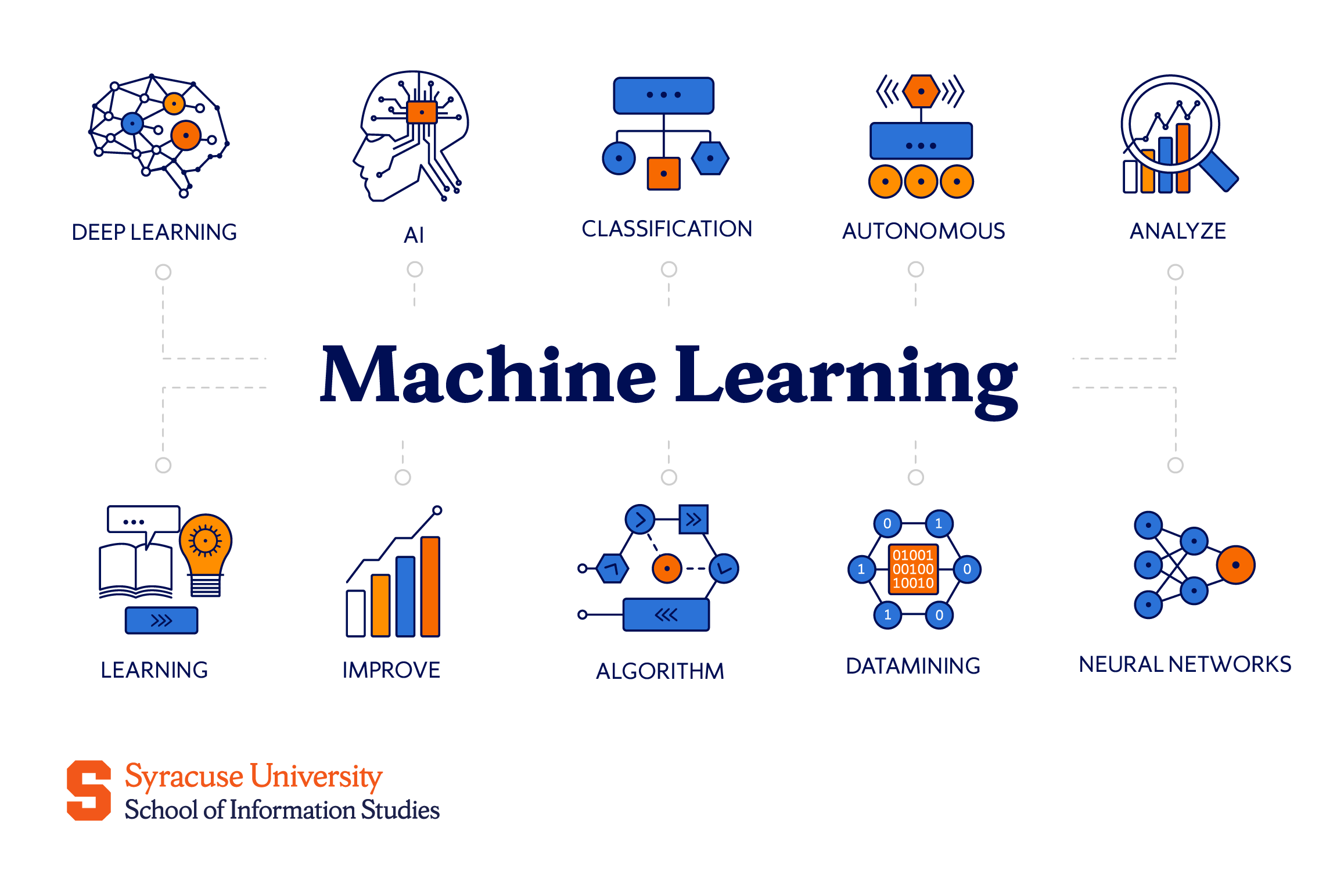
Machine Learning has become one of the most powerful technologies shaping the modern world. From voice assistants and recommendation systems to medical discoveries and self-driving vehicles, machine learning is changing the way humans interact with technology.
In simple words, machine learning allows computers to learn from data and improve their performance without being directly programmed for every single task. Instead of following only fixed instructions, machines analyze patterns, understand information, and make decisions based on previous experiences.
Today, businesses, researchers, governments, and individuals are using machine learning to solve complex problems faster and more efficiently. The technology has created new opportunities in almost every industry, including healthcare, finance, education, marketing, transportation, and entertainment.
As the amount of digital data continues to grow, the importance of machine learning is increasing rapidly. Companies are investing billions of dollars into artificial intelligence because they understand that data-driven decision-making is becoming essential for future success.
This complete guide will explain everything you need to know about machine learning, including its history, working process, types, applications, advantages, challenges, and future possibilities.
What Is Machine Learning?
Machine Learning is a branch of Artificial Intelligence (AI) that enables computers to learn from data and improve their performance over time without needing human programmers to manually update every rule.
Traditional computer programs work through predefined instructions. A developer writes specific commands, and the computer follows those commands to produce an output. However, many real-world problems are too complicated for humans to create exact instructions.
For example, identifying whether an email is spam or not requires analyzing thousands of patterns, such as words, sender behavior, links, and previous examples. Instead of writing millions of rules, machine learning algorithms can study existing data and learn how to recognize spam automatically.
A machine learning system usually works through three main steps:
1. Data Collection
The first step is gathering large amounts of information. Data can come from websites, sensors, applications, customer records, images, videos, or other digital sources.
The quality of data plays an important role because a machine learning model can only be as good as the information it receives.
2. Training the Model
During training, the machine learning algorithm studies the collected data and identifies patterns. The system learns relationships between different pieces of information and creates a model that can make predictions.
3. Making Predictions
After training, the model can analyze new information and provide results. For example, it can predict customer behavior, recognize objects in images, translate languages, or recommend products.
History and Evolution of Machine Learning
The History of Machine Learning
The journey of machine learning started long before modern computers became powerful. The idea of creating machines that could learn and improve has fascinated scientists for many decades.
The foundation of machine learning is connected with the development of artificial intelligence. In the middle of the 20th century, researchers started exploring whether computers could perform tasks that normally required human intelligence.
In 1950, British mathematician and computer scientist Alan Turing introduced the famous question: “Can machines think?” His work helped create the foundation for artificial intelligence research.
During the 1950s and 1960s, scientists began developing early computer programs that could solve mathematical problems, play games, and recognize simple patterns. One of the earliest examples was a computer program designed to play checkers and improve its performance through experience.
Over time, researchers discovered that giving computers the ability to learn from data was more effective than programming every possible situation manually. This idea became the foundation of machine learning.
The Growth of Machine Learning Through the Decades
The 1950s and 1960s: Early Experiments
The early years of machine learning focused on creating systems that could imitate basic human thinking.
Researchers experimented with:
- Pattern recognition
- Problem-solving programs
- Game-playing computers
- Basic decision-making systems
Although computers were limited by their processing power, these experiments proved that machines could improve through learning.
The 1970s and 1980s: Development of Learning Algorithms
During this period, researchers developed more advanced mathematical techniques that allowed computers to analyze information more effectively.
Important developments included:
- Neural networks
- Decision trees
- Statistical learning methods
- Expert systems
However, progress was slowed because computers did not have enough memory or processing ability to handle large amounts of data.
The 1990s: The Rise of Data-Based Learning
The 1990s brought significant changes to machine learning. The growth of the internet created enormous amounts of digital information, giving researchers more data to train algorithms.
During this time, machine learning became more practical for real-world applications.
Companies started using machine learning for:
- Email filtering
- Fraud detection
- Customer analysis
- Search engines
- Recommendation systems
One important milestone was the success of machine learning systems in games and competitions, showing that computers could outperform humans in specific tasks.
The 2000s: Big Data and Better Computing Power
The arrival of big data completely transformed machine learning.
Businesses began collecting massive amounts of information from:
- Websites
- Mobile applications
- Social media platforms
- Online transactions
- Digital devices
At the same time, improvements in computer hardware made it possible to process huge datasets faster.
Companies started using machine learning to improve:
- Online shopping experiences
- Advertising strategies
- Customer service
- Security systems
- Business predictions
The 2010s: Deep Learning Revolution
The 2010s became a major turning point for machine learning because of deep learning technology.
Deep learning uses artificial neural networks inspired by the structure of the human brain. These networks can process extremely complex information such as images, sounds, and languages.
Deep learning helped machines achieve impressive results in:
- Image recognition
- Speech recognition
- Language translation
- Autonomous vehicles
- Medical diagnosis
Technologies like virtual assistants and smart recommendation systems became popular because of advances in machine learning.
The 2020s and Beyond: The Age of Intelligent Systems
Today, machine learning is one of the fastest-growing areas of technology.
Modern machine learning systems are capable of:
- Understanding human language
- Creating images and content
- Detecting diseases
- Predicting market trends
- Improving business operations
- Supporting scientific research
Artificial intelligence and machine learning are becoming important parts of everyday life.
From smartphones to online services, many technologies people use daily depend on machine learning algorithms working behind the scenes.
How Does Machine Learning Work?
Understanding how machine learning works helps explain why this technology is so powerful.
At its core, machine learning is based on the relationship between data, algorithms, and models.
A machine learning system receives information, analyzes patterns, learns from examples, and creates a model that can make decisions.
The process can be divided into several important stages.
1. Collecting Data
Data is the most important part of machine learning.
Without high-quality data, even the most advanced algorithm cannot produce accurate results.
Machine learning systems use different types of data, including:
Structured Data
Structured data is organized information that fits into tables or databases.
Examples:
- Customer information
- Sales records
- Financial transactions
- Product details
Unstructured Data
Unstructured data does not follow a specific format.
Examples:
- Images
- Videos
- Audio files
- Social media posts
- Documents
Modern machine learning systems can analyze both structured and unstructured data.
2. Preparing the Data
Before training a machine learning model, data needs to be cleaned and organized.
This process is called data preparation or data preprocessing.
It includes:
- Removing incorrect information
- Handling missing values
- Organizing categories
- Converting data into useful formats
High-quality preparation improves the accuracy of machine learning models.
3. Choosing a Machine Learning Algorithm
An algorithm is a set of mathematical instructions used by computers to learn from data.
Different problems require different algorithms.
For example:
- A recommendation system may use collaborative filtering.
- An image recognition system may use neural networks.
- A prediction system may use regression algorithms.
Choosing the correct algorithm is important for achieving better results.
4. Training the Machine Learning Model
Training is the stage where the machine learns from available data.
During training, the algorithm analyzes examples and identifies patterns.
For example:
A machine learning system that recognizes cats in images will study thousands of pictures of cats and non-cat images. Over time, it learns important features such as shapes, colors, and patterns.
After training, the model can analyze new images and predict whether they contain a cat.
5. Testing and Improving the Model
After training, the model must be tested to measure its accuracy.
Developers evaluate:
- How often the model makes correct predictions
- Where mistakes happen
- How performance can be improved
The model may be adjusted several times until it produces reliable results.
6. Deployment
Once a machine learning model performs well, it can be used in real-world applications.
Examples include:
- Online recommendation systems
- Fraud detection software
- Medical analysis tools
- Voice recognition applications
After deployment, models are often updated with new data to maintain accuracy.
Frequently Asked Questions (FAQs) About Machine Learning
1. What is Machine Learning in simple words?
Machine Learning is a technology that allows computers to learn from data and improve their performance without being directly programmed for every task. Instead of following only fixed instructions, machines identify patterns, learn from previous examples, and use that knowledge to make predictions or decisions.
2. What are the main types of Machine Learning?
The main types of Machine Learning are Supervised Learning, Unsupervised Learning, Semi-Supervised Learning, and Reinforcement Learning. Each type works differently depending on the kind of data available and the problem that needs to be solved.
3. Why is Machine Learning important today?
Machine Learning is important because it helps businesses, researchers, and organizations analyze large amounts of data quickly and make better decisions. It is used in healthcare, finance, education, marketing, cybersecurity, transportation, and many other industries.
4. Is Machine Learning difficult to learn?
Machine Learning can be challenging because it requires knowledge of mathematics, programming, and data analysis. However, beginners can learn it step by step by understanding basic concepts, practicing programming languages like Python, and working on simple projects.
5. What is the future of Machine Learning?
The future of Machine Learning is expected to bring more advanced intelligent systems that can solve complex problems and improve human productivity. As technology continues to develop, Machine Learning will become an important part of industries, businesses, and everyday life.
Conclusion
Machine Learning has become one of the most transformative technologies of the modern era. It has changed the way computers understand information, solve problems, and support human decisions. From improving healthcare and education to enhancing business operations and creating smarter digital experiences, machine learning continues to expand its influence across the world.